
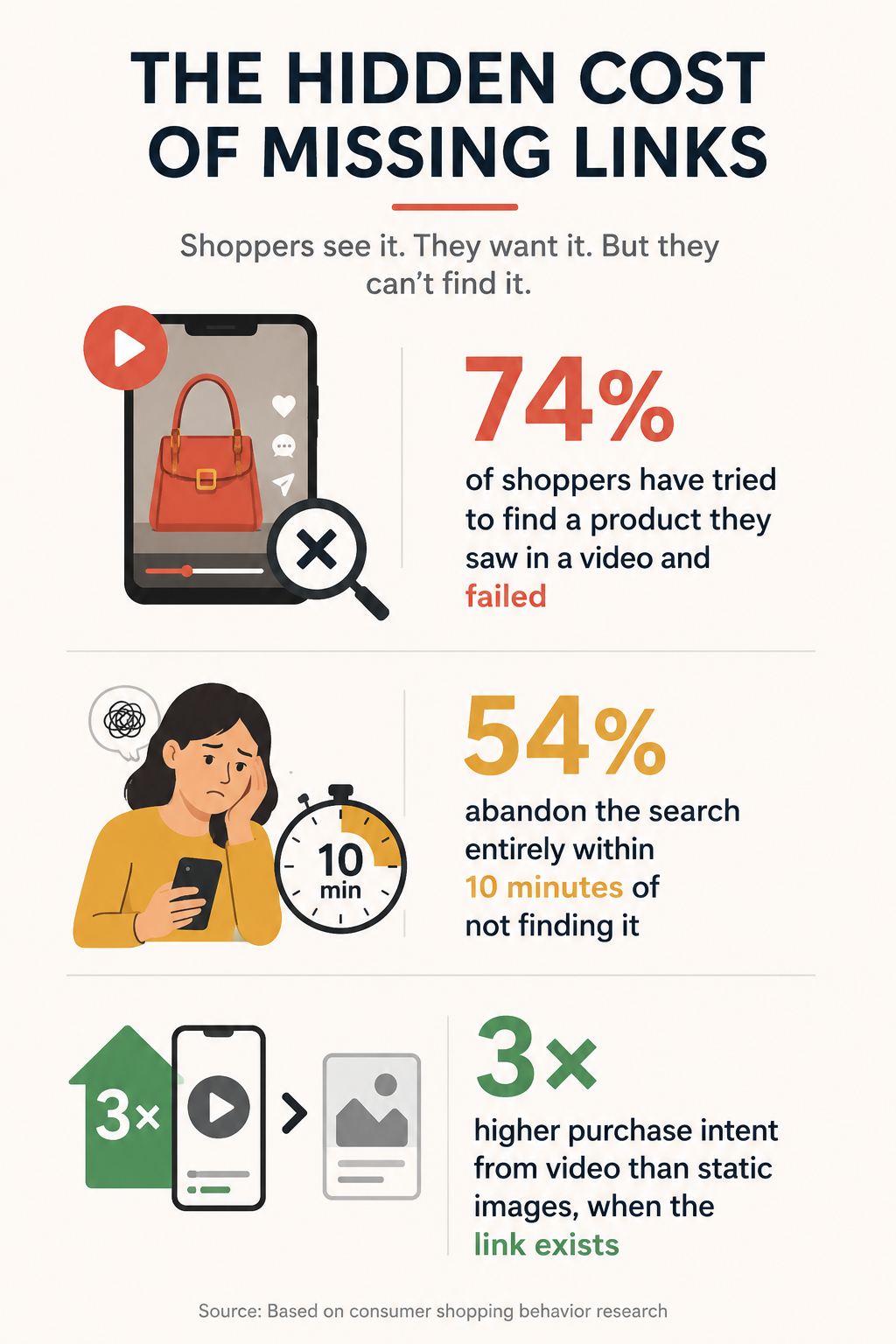
There is a moment that every social media scroller knows. Something in a video stops you cold. Maybe it is a lamp glowing softly in the background of a morning routine. Maybe it is a bag worn so casually the creator never once mentions it. Maybe it is a pair of sneakers visible for two seconds before the cut. The video moves on. The reel ends. But you cannot let it go.
What follows is one of the most quietly maddening experiences in modern shopping: the product hunt. You screengrab the frame. You reverse image search it. You scroll to the comments hoping someone has already done the detective work. You type "what is that bag" and wait. Sometimes a kind stranger has the answer. Most of the time, they do not. And the creator who posted and moved on has no idea you are out there, wanting.
This scene plays out millions of times every single day across Instagram, TikTok, YouTube Shorts and Pinterest. It is one of the largest untapped frustrations in all of ecommerce, and one of the biggest missed opportunities in retail history. A shopper who spots something they love in a video is already sold. They have crossed the hardest bridge there is: desire. All that stands between them and a purchase is a link. And yet for millions of shoppers every day, that link simply does not exist.
The gap between "I want this" and "I found it"
Social media was never built for shopping, even though shopping has made itself completely at home there. The reel format is extraordinary at creating desire. It is terrible at converting it. A creator can spend hours crafting a video that makes a product look absolutely irresistible, then drop it into a feed with no link, no tag, no brand mention and no breadcrumb for a viewer to follow. The desire is real. The path to purchase is not. Everyone loses.
Platforms have been slow to fix this. Product tagging exists but it is inconsistently used and even more inconsistently noticed. The gap between seeing something and buying it remains stubbornly wide for the vast majority of social video content. Shoppers fall into it every day, and most of them never climb back out.
What desperation actually looks like
The search spiral has a very predictable shape. It begins with optimism: a quick Google, a reverse image search, a screenshot sent to a group chat with "does anyone know where this is from?" Then comes effort: scrolling through the creator's past posts, checking their link in bio, hunting through story highlights, sending a DM that will almost certainly go unanswered. Then comes frustration: the slow realization that the information either does not exist online or is buried somewhere completely unreachable. And finally, for most shoppers, comes resignation. They close the tab. They tell themselves they will look later. They do not.
For a smaller and more determined group, desperation tips into obsession. These are the shoppers posting in subreddits, joining Facebook groups built entirely around identifying products from videos, submitting screenshots to "name this item" communities and waiting days for a response. They are doing, without knowing it, the work that the creator and the platform should have made completely unnecessary.
- Screenshot the frame and run a reverse image search
- Check the video description and comments for any clues
- Visit the creator's link in bio and scroll their storefront
- Search the creator's other posts for a mention of the brand
- DM the creator directly, usually with no reply
- Post in a "what is this product" community or subreddit
- Try increasingly creative keyword combinations on Google
- Give up, or stumble across it by accident weeks later
What it costs everyone
For brands, the numbers are painful. Video content drives purchase intent at rates far higher than static photos, but only when the path to purchase is actually clear. When it is not, brands are paying for awareness they cannot convert. The viewer knows the product exists. They may desperately want it. They just cannot find it, and after a certain point they stop trying.
The frustration also leaves an emotional mark. A shopper who wanted something and could not find it does not simply forget. They carry a faint disappointment, sometimes even a quiet resentment, even if the brand had nothing to do with the breakdown. They saw it. They wanted it. They felt let down. That feeling sticks around.
For creators the cost is different but just as real. Every unanswered "where is this from?" sitting in the comments is a missed commission, a missed brand relationship and a missed chance to be genuinely useful to an audience that already trusts them. Creators who link everything, who make finding the product effortless, consistently report stronger engagement, deeper audience loyalty and better brand deals. The link is not just a convenience. It is a signal that says: I thought about you.
The breaking point
Most shoppers do not rage quit. They do not leave angry reviews or send furious messages. Their breaking point is quieter and more final than that. It is the moment they close the tab and decide that their wanting simply was not worth the effort. No dramatic exit. Just a door that closes softly and does not open again.
That quiet moment is the one every creator, every brand and every platform should be working hardest to prevent. Because the shopper who gave up was already yours. They had done the hard part. They had stopped scrolling, felt something and decided they wanted it. All they needed was a way to get there.
Make it easy to find. Make the search unnecessary. Because the cost of that closed tab is not just one lost sale. It is every sale that shopper would have made, and every recommendation they would have given, and every moment of trust that gets quietly, permanently withdrawn.