
Your content has a 48-hour window. Here's how to extend it.
By Greg Lewis · May 19, 2026
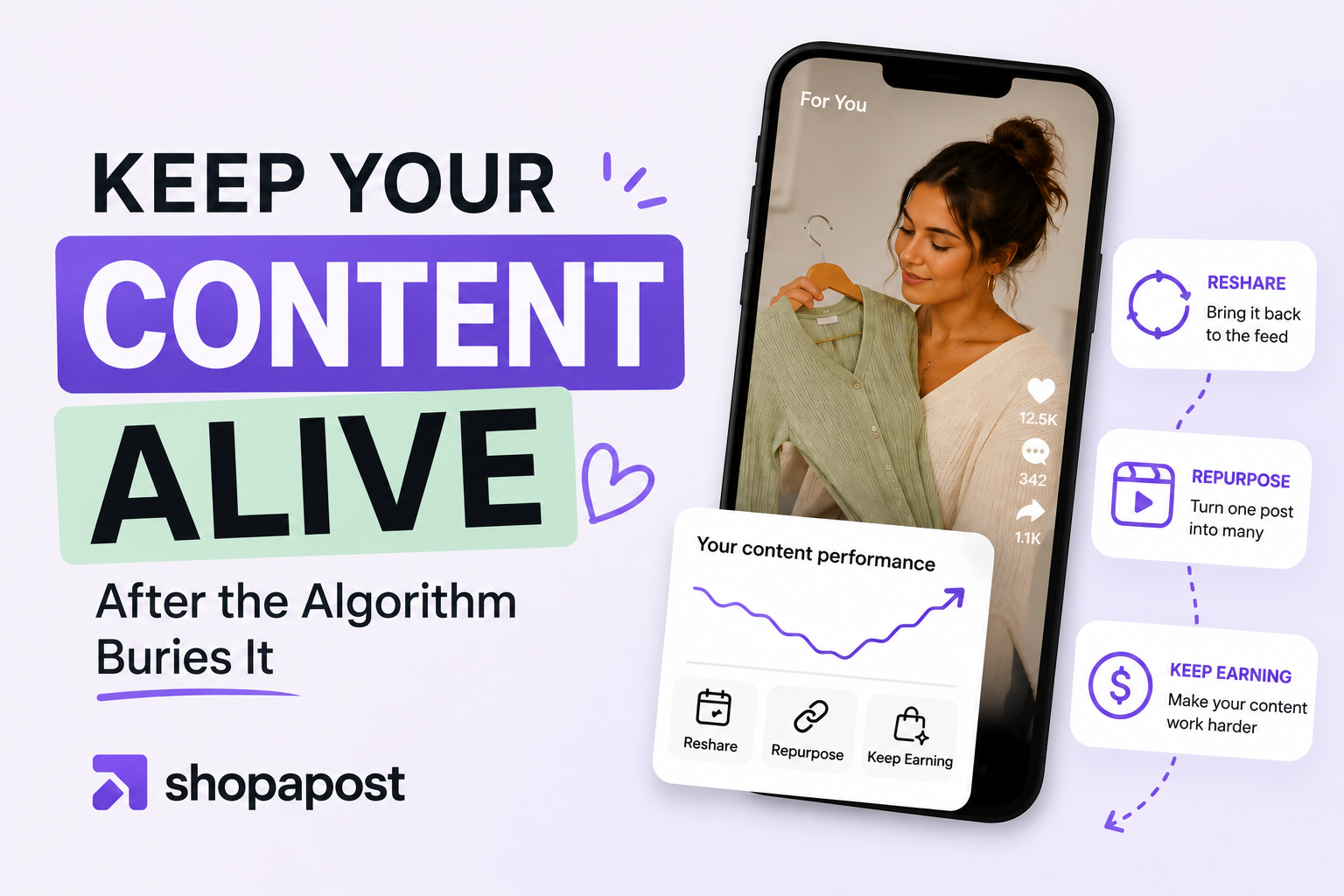
The algorithm buries most posts within two days. But what if the post kept working long after the feed moved on?
Your content has a 48-hour window. Here's how to extend it indefinitely.
The algorithm buries most posts within two days. But what if the post kept working long after the feed moved on?
You spend an hour filming. Another hour editing. You post, it gets traction — maybe even a few thousand views — and then, almost overnight, it's gone. The feed moves on. The algorithm finds something newer. Your carefully crafted content quietly disappears into the archive.
This is the brutal reality of social media in 2026. Platforms like TikTok and Instagram are optimized for novelty. Their algorithms are extraordinarily good at surfacing the new and burying the old. Unless a post goes viral within the first 24 to 48 hours, it typically enters a kind of digital purgatory — technically accessible but practically invisible.
For creators building a business around their content, this is more than just frustrating. It's a fundamental structural problem.
The algorithm rewards engagement signals — not age
Here's what most creators don't fully appreciate: the algorithm doesn't actually care about how old a post is. What it cares about is engagement signals — clicks, saves, shares, comments, and time spent. Age is a proxy for engagement decay, not a rule. A post that keeps generating engagement signals doesn't decay the same way.
This is the key insight. If you can create a reason for people to keep clicking through to your content — from outside the platform — you're feeding the algorithm exactly what it wants. You're telling it: this post is still relevant. People are still interested. Keep showing it.
External traffic isn't just about affiliate earnings. It's a signal to the algorithm that your content is still alive.
External links driving traffic back to an original post can meaningfully extend its algorithmic lifespan. The platform sees incoming engagement and interprets it as a sign of ongoing relevance. The post gets another look. The cycle continues.
The missing piece: a shoppable home for your content
Most creators think about content and commerce as separate tracks. You post content to build an audience. You build an audience to eventually monetize. The two things happen in sequence, and the monetization window is narrow.
What if content and commerce happened simultaneously — and indefinitely?
The idea is simple. When you create content featuring products, places, outfits, gear, or anything purchasable, that content has commercial value that exists independently of its algorithmic shelf life. Someone finding that post six months later through a Google search, an AI recommendation, or a shared link is just as likely to buy as someone who saw it the day it went live.
The problem is there's historically been no clean way to capture that value. Bio links are blunt instruments. Affiliate links buried in comments get lost. The purchase intent exists — the infrastructure to capture it hasn't.
What keeping content alive actually looks like
The mechanics are worth understanding. When a piece of content has a dedicated, crawlable, SEO-optimized page associated with it — a page that links back to the original post and organizes the products featured in it — several things happen at once.
First, that page becomes a persistent destination. It lives on search engines. It gets indexed by AI assistants. It can be shared in newsletters, pinned in bios, dropped in group chats. Every one of those touchpoints is a potential traffic source that didn't exist when you just posted to your feed and hoped for the best.
Second, every visit to that external page that results in a click back to your original content is a fresh engagement signal. The post gets activity. The algorithm notices. The burial slows.
Third — and this is the compounding part — affiliate links on that page convert regardless of when someone visits. A post about kitchen gear from eight months ago that lives on a well-structured product page can keep generating commission every week, indefinitely, as long as people find the page and buy.
Evergreen commerce is what happens when content stops being a moment and becomes a destination.
The creator-first model
There's an important distinction worth drawing here. Not all shoppable link tools are built the same way, and the ownership model matters enormously.
The best versions of this approach are built with the creator in mind from the start. That means unclaimed pages — pages generated from content that the creator hasn't yet set up — should default to earning on behalf of the creator, with the platform only capturing value for truly unclaimed, orphaned content. It means creators can bring their own affiliate IDs. It means the traffic data belongs to the creator, not just the platform.
This is the difference between a tool that monetizes creators and one that monetizes alongside them.
Start thinking in destinations, not just posts
The mental shift required here is real but not complicated. Instead of thinking "I'm posting a video," start thinking "I'm creating a content destination." The video is the hook. The shoppable page is the landing spot. The affiliate link is the monetization layer. The link back to the original is the algorithmic lifeline.
Every piece of content you create has a longer tail than the algorithm currently gives it credit for. The question is whether you build the infrastructure to capture that tail — or leave it on the table.
Your content deserves a longer life than 48 hours. The tools to give it one exist. The only thing left is to use them.
Ready to turn your posts into lasting shoppable destinations? Try ShopaPost free.
Creator commerce changes every week. I read everything so you don't have to.
One email a week. What's working in affiliate and creator commerce right now, from someone doing this since 1997. No fluff, no pitch fests, unsubscribe anytime.