
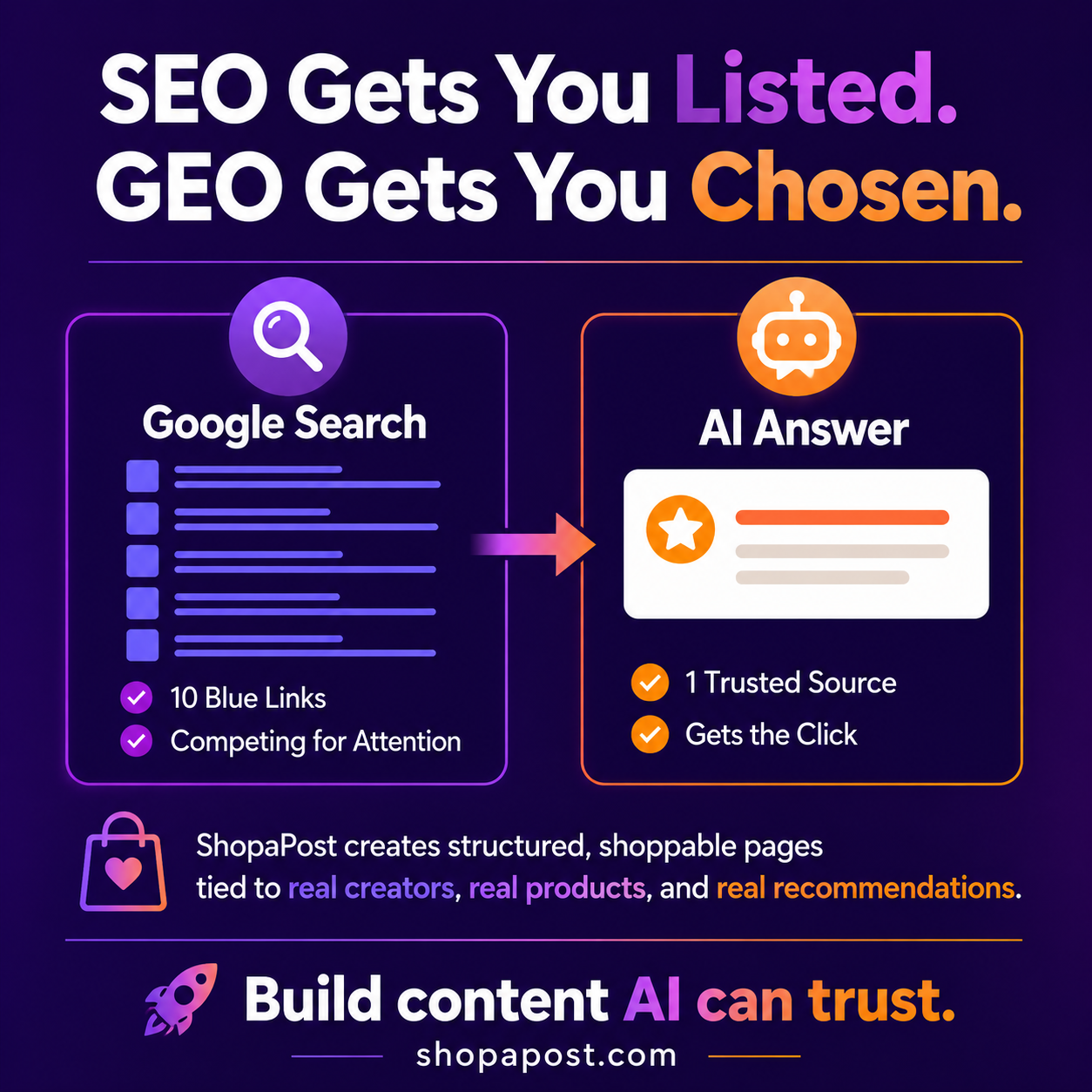
For the last twenty years, the game was simple. You created content, Google indexed it, shoppers searched, they found you. That was SEO. And it worked.
Then something shifted.
Shoppers stopped typing "best standing desk under $400" into Google and started asking ChatGPT. They stopped clicking ten blue links and started trusting one answer. AI didn't just change how content is discovered — it changed what gets trusted, what gets cited, and ultimately what gets bought.
This new game has a name: GEO. Generative Engine Optimization. And most creators, brands, and affiliate marketers have no idea it's already happening to them.
What GEO actually means
Search engines ranked pages. AI engines recommend sources. That is not a small distinction. When Google ranked your page, it sent traffic and let the user decide. When ChatGPT, Perplexity, or Google's AI Overviews answer a question, they are making a judgment call about who to trust — and only then sending the shopper somewhere.
The question isn't just "does your content exist." It's "does your content look trustworthy enough for an AI to stake its answer on it."
AI engines are not looking for the most popular page. They are looking for the most structured, specific, and credible source — one that matches the intent of the question with enough precision to cite confidently.
This is where most link-in-bio tools, affiliate dashboards, and social profiles completely fall apart. They are not structured. They are not specific. They are a collection of links with no context, no attribution, and no signal that says: this is a trustworthy source about this product, in this category, for this kind of shopper.
The trust layer AI is actually looking for
When an AI engine evaluates whether to cite a source, it is effectively asking three questions:
Is this page about a specific, real thing? Is the information structured and attributable? Does it exist within a credible, consistent context?
A shoppable page built on ShopaPost answers all three. It is tied to a specific piece of content — a YouTube video, a TikTok, a blog post. It contains real products, real affiliate links, and real categories. It exists within a named creator's shop, which carries its own identity and history. It is not a generic landing page. It is a structured, contextual, product-specific resource.
That is exactly what generative engines are trained to surface.
Why this matters more than follower count
Here is the uncomfortable truth for anyone still chasing likes and follows: AI doesn't care how many followers you have. It cares whether your content is useful enough to repeat.
A creator with 800 followers and a well-structured shoppable page on ShopaPost can get cited by an AI answering "what home office gear do YouTubers actually use" — and drive more purchase intent than an influencer with 200,000 followers whose affiliate links are buried in a PDF no one reads.
The era of reach-as-proxy-for-trust is ending. Structured content wins. Specific wins. Attributable wins.
What ShopaPost pages look like to an AI engine
Every ShopaPost page is generated from a content source — a video, a post, an article. That means it has provenance. It has a creator. It has a category. It has products with names, prices, and links. It is not scraped or generic — it is traceable back to a human who made a recommendation.
AI engines are increasingly designed to surface exactly this kind of content, because it is what their users actually want. When someone asks an AI "what backpack does MrBeast use" or "what skincare does that dermatologist on TikTok recommend," the AI needs a structured, citable answer — not a link farm.
ShopaPost is not just a tool for earning affiliate commissions today. It is infrastructure for the AI shopping era — a way to make your recommendations findable, citable, and trustworthy in a world where the middleman is no longer a search engine, it's a language model.
The window is open right now
GEO is not mature yet. The playbook is not written. The creators and brands who understand this shift first — who build structured, specific, attributable shoppable content now — will own the citations when the market consolidates.
This is the first-mover window. It is smaller than the SEO window was in 2005, and it is closing faster.
The creators who act now will not just earn commissions. They will become the sources that AI trusts. And in the GEO era, being a trusted source is worth more than any follower count ever was.
Build your ShopaPost shop today. Not because it earns you commissions this week — though it will — but because it puts you inside the trust layer that the next decade of shopping will run on.
Start building your shop today
Paste any YouTube, TikTok, or blog link and your shoppable page is live in seconds. Free to start. No brand deals needed.
Build your first shop at shopapost.com