
Your best content was published two years ago.
By Greg Lewis · May 30, 2026
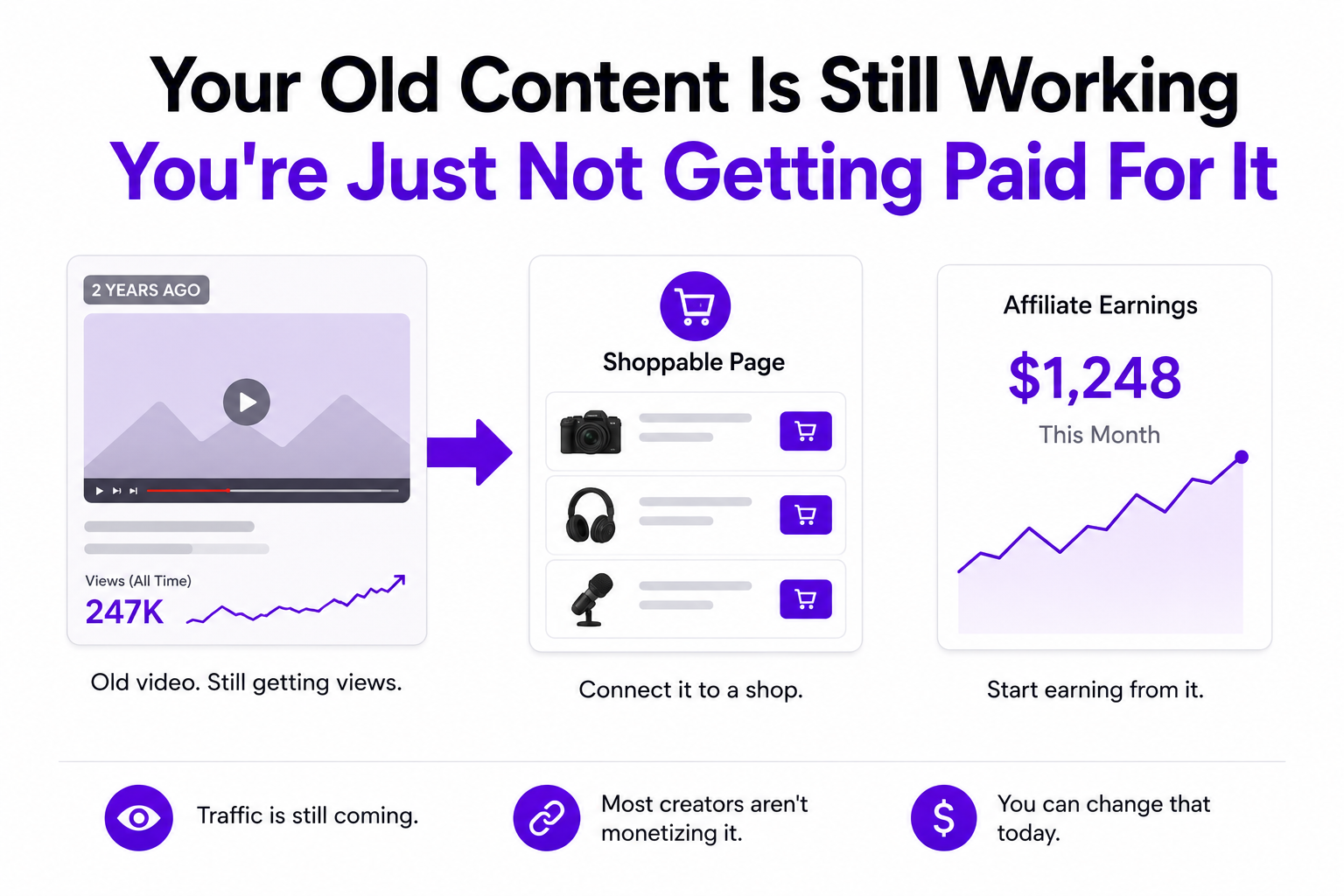
Your best content was published two years ago. Here's how to start earning from it today.
The algorithm moved on. The searches didn't. Your old videos and posts are still pulling traffic — they're just not connected to anything that pays you.
Ask any creator with more than a year of content what their best-performing video is. Most of them will name something they posted 18 months ago — maybe longer. A review, a build, a tutorial that just quietly kept getting views long after the upload hype died.
Now ask them if that video earns anything. Usually the answer is no, or almost nothing. Maybe a thin affiliate link in the description that went live on day one and hasn't been touched since.
This is the quiet version of the same problem every creator faces. The algorithm buries new posts within 48 hours. But old content has a different problem — it never had the infrastructure to earn in the first place.
The traffic is already there
Here's what most creators don't track: the majority of views on YouTube go to videos older than 30 days. Search doesn't care when something was published. It cares whether it answers the question.
That three-year-old gear review. The tutorial from 2022. The product haul that got a modest 8,000 views and then disappeared from your mind — those videos are still being found. People are still watching them. And those viewers are arriving with intent. They searched for something specific, found your video, and watched it because it matched what they needed.
New content is optimized for the feed. Old content is optimized for search. Search audiences buy more.
The difference between a feed viewer and a search viewer is enormous. Feed viewers are browsing. Search viewers are deciding. That's the audience sitting inside your back catalog right now — and most creators have nothing waiting for them when they arrive.
What's actually happening when someone finds your old content
A viewer finds your 2023 gear review through a YouTube search. They watch it. They want to buy the thing you recommended. They click to your description — and find a broken affiliate link, a product that's out of stock, or a generic Amazon homepage with no context. They leave. You earned nothing from a viewer who was ready to spend.
This happens thousands of times across a creator's back catalog every month. It's not a traffic problem. It's an infrastructure problem. The content is working. The monetization layer was never built to last.
A link added at upload is a snapshot. It captures the moment but not the tail. What back-catalog content needs is a living page — one that stays accurate, stays shoppable, and stays connected to the original video no matter when someone finds it.
How to actually fix it
The good news is you don't need to re-edit anything. You don't need to re-record. The content is already done. What's missing is a shoppable page built around what you already said — one that pulls every product mention from your video and turns it into a clean, affiliate-linked destination.
Start with your top ten videos by all-time views, not recent views. These are the ones with proven, ongoing traffic — your highest-leverage assets. Paste each URL into ShopaPost. It reads the transcript, identifies every product you mentioned, matches them to live affiliate links, and builds a shop page without you writing a word.
Then update each video description once. Swap the old link for the new shop link. One edit per video. Every future viewer — arriving today, next month, or two years from now — lands on a page that actually works.
One creator's three-year-old "best budget tools" video now drives more affiliate clicks from its shop page than from the video description — because the shop ranks in Google for product-specific terms the video never could.
The compounding effect matters here. Shop pages are indexed by search engines independently of the original video. Over time they begin pulling their own traffic — people who never watched the video but found the shop through a product search. The content created the authority. The shop captures the demand.
The math most creators never run
If your top ten back-catalog videos collectively pull 5,000 views a month — conservative for any creator with more than a year of content — and even 2% of those viewers click through to a shop link, and 5% of those convert at a $40 average order, that's $200 a month in passive affiliate revenue. From content that's already done. Content you're not promoting, not updating, not thinking about.
Most creators have never done this math because they've never had a shop page worth linking to. A link-in-bio doesn't cut it. An Amazon storefront with 80 unrelated products doesn't convert. What works is a page tied directly to the specific video someone just watched — same products, same context, same voice.
That specificity is what turns a viewer into a buyer. And it's what's been missing from back-catalog monetization until now.
Start with what you already have
The most underutilized asset in most creators' businesses isn't a new content format or a new platform. It's the archive. Videos that already rank. Posts that already get found. Content that already has an audience — just not the infrastructure to earn from it.
You did the hard part. You made the content. The question is whether you build the layer that lets it keep working — or leave that traffic on the table indefinitely.
Your back catalog is already earning attention. It should be earning revenue too.
Ready to turn your existing content into a permanent affiliate revenue stream? Try ShopaPost free.
Creator commerce changes every week. I read everything so you don't have to.
One email a week. What's working in affiliate and creator commerce right now, from someone doing this since 1997. No fluff, no pitch fests, unsubscribe anytime.