Google Just Rewired How People Buy — And Your Recommendations Are About to Disappear
By Greg Lewis · June 8, 2026
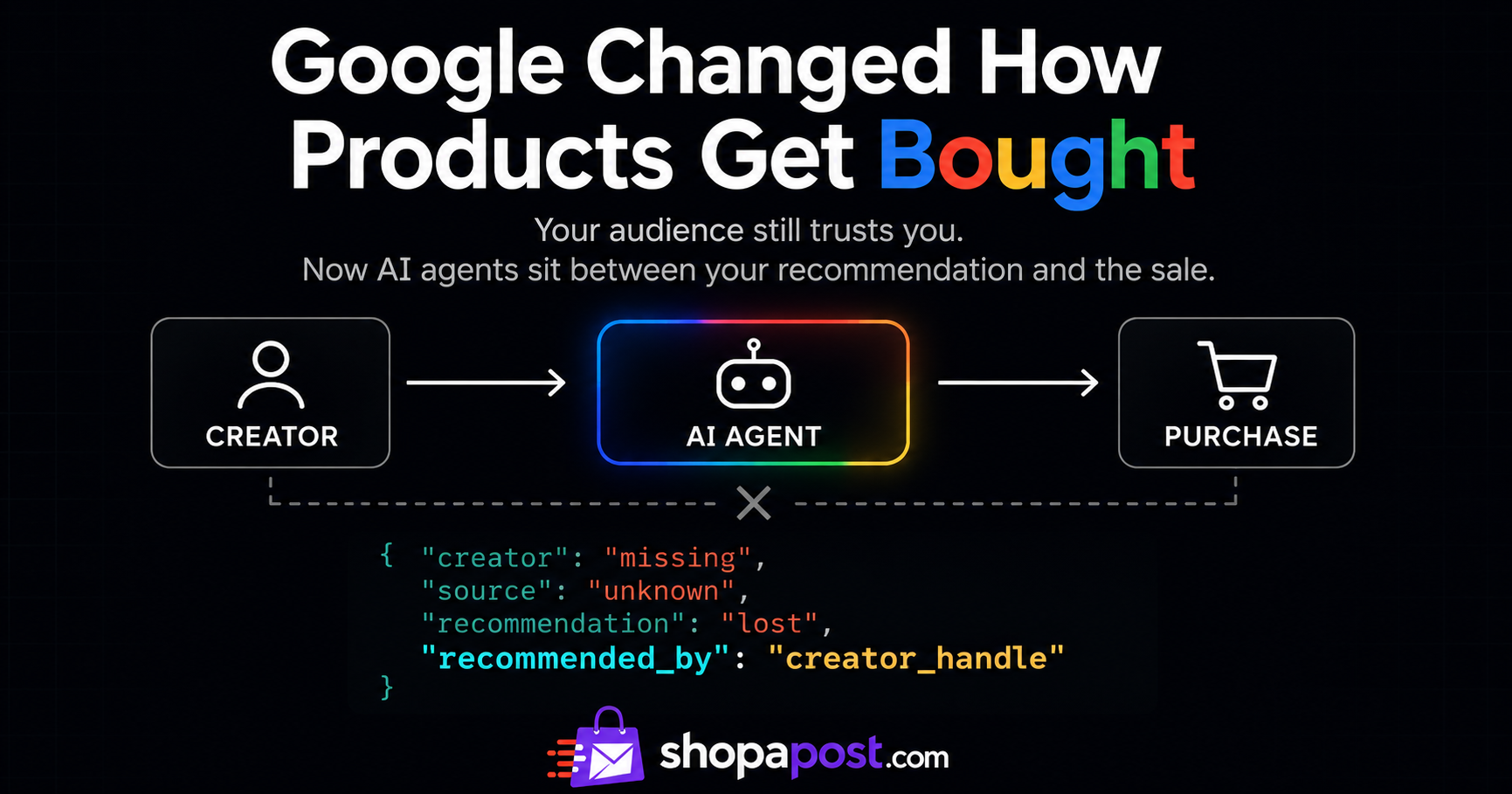
Google's Universal Cart and AI agent payments don't just change SEO — they erase the link between your recommendation and the sale. Here's what that means for your brand, your income, and what to do before the window closes.
You spent months building your audience. You found your niche. You figured out what your people trust you to recommend — skincare, gear, home setups, kitchen tools, whatever it is. You post, they watch, they buy. That's the deal.
Google just changed the deal. And almost nobody is talking about what it means for you specifically.
What Actually Happened at Google I/O 2026
In May 2026, Google announced three things that, taken together, quietly dismantle the way creator recommendations turn into income.
First: Universal Cart. Users can now add products from YouTube, Search, Gmail, and Gemini into one persistent Google shopping cart and check out without ever visiting a store — or a creator's shop page, or a link in bio. They see your Reel. They see the product. Google adds it to cart. Done. You were never in the loop.
Second: AP2 — the Agent Payments Protocol. Google's AI agents can now make purchases autonomously on a user's behalf, within spending limits the user sets. The user doesn't browse. They don't click. They don't even open a browser. The agent detects a need, finds a match, and buys. The April 2026 update introduced what Google calls "Human Not Present" payments — purchases that complete while your viewer is doing something else entirely.
Third: a Search core update that pushed AI-generated answers and AI Overviews onto nearly half of all Google queries. The traffic that used to flow through creator content toward purchase pages is being absorbed before it ever reaches you.
Taken together, these three things do one thing to your business: they insert Google between your recommendation and the sale.
Here Is the Problem That Nobody Is Naming
Right now, when someone watches your video and buys the product you recommended, you get credit for that. Your affiliate link was clicked. Your tag was in the URL. The retailer knows the sale came from you. That's how you get paid.
In the agentic commerce world Google is building, the AI intercepts the purchase. The click — your click, the one attached to your affiliate tag — doesn't happen. Google's Universal Cart processes the transaction. The product ships. The customer is happy. And you made nothing, because your recommendation was the spark that lit the fire, but the fire department showed up before anyone could trace it back to you.
This isn't hypothetical. It's already being built. The infrastructure is live. The question is only how fast it scales — and whether your recommendations are structured in a way that survives the transition.
What "Structured" Means and Why You Don't Have It Yet
Here's a word you're going to hear a lot in the next 18 months: structured data. It sounds technical. It isn't, not really. It just means: can a machine read what you're recommending, why you're recommending it, and connect that back to you by name?
Right now, your recommendations live in captions, in spoken words inside videos, in bio links that point to a general page. None of that is readable by an AI agent deciding what to buy. It's noise. The agent skips it and goes straight to the product listing — which has no record of you.
Structured creator commerce means your recommendation is attached to your identity in a format machines can read and act on. Product name. Your name. The content it came from. The reason you recommended it. A link that survives the agent layer and connects the sale back to you.
That's not something you can build yourself. It's not something a link-in-bio page does. It requires infrastructure built specifically for this moment — a shop that exists not just for human visitors, but for AI agents making decisions on your audience's behalf.
What Happens to Your Brand If You Don't Adapt
Let's be specific about what you stand to lose, because it's more than commission dollars.
Your recommendations become raw material for someone else's business. Google's Shopping Graph now contains 60 billion product listings. Those listings have no creator attached to them. When your audience asks Gemini "what's a good wireless keyboard," Gemini answers from that graph — not from your video where you spent eight minutes explaining exactly why the one you use is worth it. Your expertise feeds the machine. The machine takes the credit.
Your analytics will stop making sense. You'll see views. You'll see engagement. You won't see clicks, because clicks are disappearing. You'll look at your affiliate dashboard and wonder why your conversion rate is collapsing when your content is performing better than ever. The disconnect between audience trust and income will feel like a personal failure. It isn't. It's a structural shift in where the transaction happens — and it's happening without you.
Your audience will buy the wrong thing. When an AI agent makes a purchase decision based on incomplete product data, it doesn't know which version of the product you actually use, which colorway you tested, which size runs small. Your recommendation was specific. The agent's fulfillment is generic. Your audience gets a mediocre experience, associated with your name, on a purchase you never controlled.
Your brand becomes decorative. You become the entertainment layer — the thing that creates desire — while someone else's infrastructure captures the transaction. You get the views. Google gets the margin. The brand you've spent years building into a trusted recommendation engine quietly loses the only thing that made it financially sustainable.
The Shift That Changes Everything
The buyer making your viewer's next purchase decision isn't your viewer anymore. It's their AI agent, shopping on their behalf, filtering through structured product data, looking for signals it can trust.
That agent isn't looking for your caption. It's not watching your Reel. It's querying a product graph, and right now, your name is not in that graph. Your curated recommendation, your specific endorsement, the reason your audience trusts you — none of that is legible to the machine making the purchase.
The creators who survive this shift are the ones whose recommendations are machine-readable before agentic commerce reaches full scale. Not because the human connection disappears — it doesn't. Your audience still discovers things through you. But discovery and purchase are separating into two distinct events happening in two distinct systems. You need to be present in both.
What You Can Do Right Now
The answer is not to post more. The answer is not to add more links. The answer is to make what you already create legible to the machines that are increasingly sitting between your recommendation and your audience's wallet.
That means having a creator shop that doesn't just list products for human browsers — it exposes structured, agent-readable product data tied to your identity and the content it came from. It means your recommendation carries a provenance record: this product, from this creator, from this video, at this date. An audit trail that survives the agent layer and connects the sale back to you when the purchase completes.
It means treating your recommendation graph — the body of products you've endorsed, tested, and stood behind — as an asset that needs to be protected and structured, not just scattered across captions and bio links that disappear when a platform changes its algorithm.
ShopaPost exists to do exactly this. It takes the content you're already creating — YouTube videos, Reels, Shorts, TikToks — and builds an agent-readable creator shop from it automatically. Your recommendations stay tied to your name. Your shop is structured for both human visitors and AI agents. When agentic commerce scales and the purchase happens without a click, the record still shows it came from you.
The window to establish this before the big platforms build their own walled-garden version of it is not years. It's months.
The Honest Bottom Line
Short-form video isn't dying. Discovery isn't dying. Your audience's trust in you isn't dying.
What's dying is the unstructured, link-dependent, click-based chain that connects your recommendation to your income. That chain has been the default for a decade. Google just announced — plainly, at a public developer conference, with live demos — that they are replacing it with something that routes around you entirely unless you're structured to intercept it.
You built something real. An audience that trusts you. A reputation for knowing what's worth buying. That's the hardest part of this whole equation, and you already did it.
Don't let the infrastructure layer — the part machines are taking over — be the thing that breaks it.
Get your recommendations structured. Get your shop agent-readable. Get your name attached to your recommendations in a format that survives the shift that's already happening.
The creators who do this in the next six months will look very smart in 2027. The ones who don't will spend that year trying to figure out why their most trusted content stopped converting.
You already know what you recommend. ShopaPost makes sure the machines know it too.
Creator commerce changes every week. I read everything so you don't have to.
One email a week. What's working in affiliate and creator commerce right now, from someone doing this since 1997. No fluff, no pitch fests, unsubscribe anytime.