
Stop Asking "What Should I Post Today." Ask This Instead.
By Greg Lewis · June 15, 2026
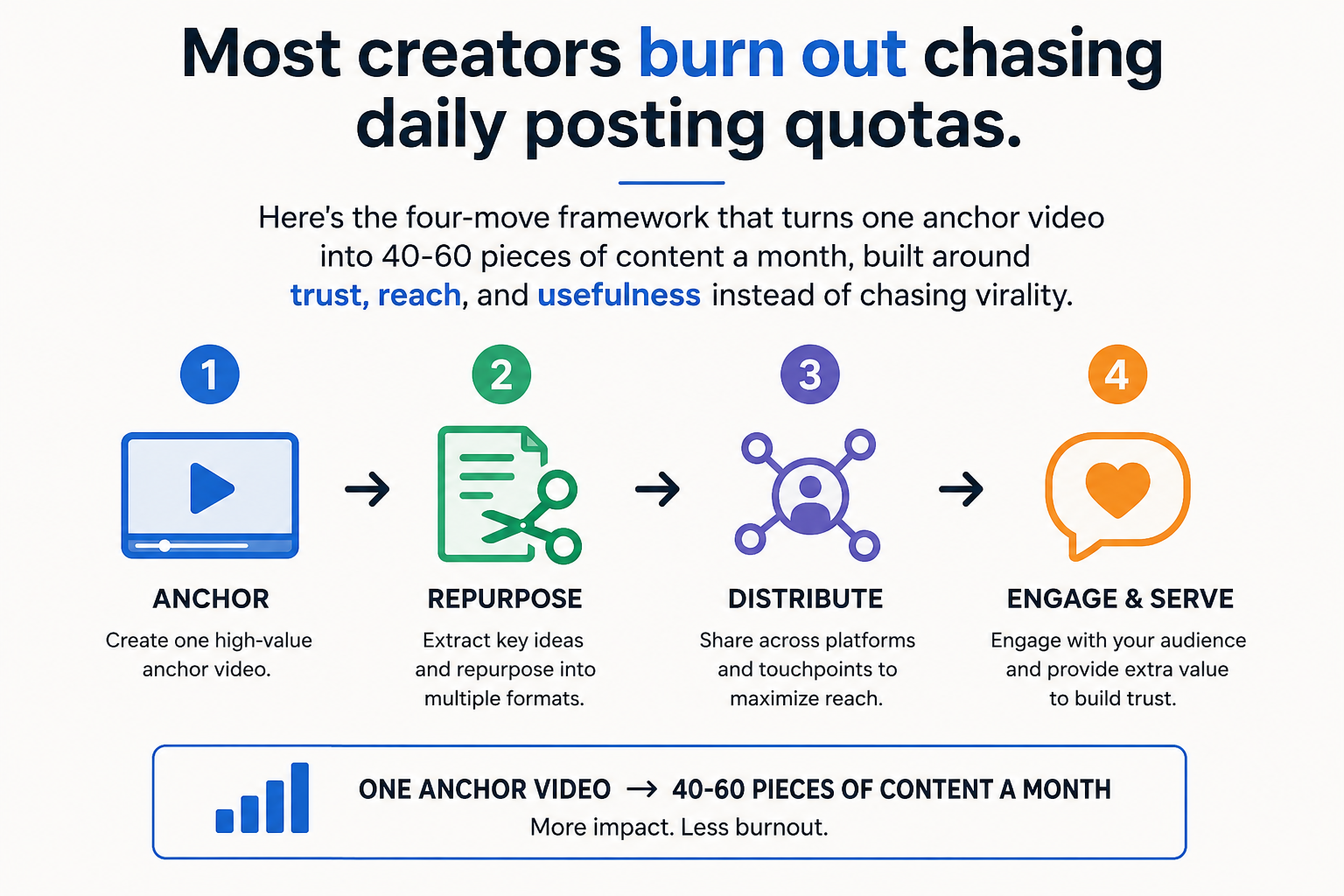
Most creators burn out chasing daily posting quotas. Here's the four-move framework that turns one anchor video into 40-60 pieces of content a month, built around trust, reach, and usefulness instead of chasing virality.
Stop Asking "What Should I Post Today." Ask This Instead.
Every Monday it's the same scramble. Open the apps, stare at the blank caption box, wonder what the algorithm wants this week. If that's your routine, you're not behind because you're lazy. You're behind because you're solving the wrong problem.
The post is not the unit. The idea is. That single shift changes everything downstream, from how much you create to how little time you spend creating it.
Why "More Content" Was Never the Goal
Most creators treat content like a treadmill. Run faster, post more, hope something sticks. But virality is the wrong game if you're actually trying to build something, whether that's a following, a shop, or a brand people trust enough to buy from.
A single piece of content that goes viral and disappears does nothing for your authority. What moves the needle is a system where every post does one of three jobs on rotation:
- Trust — content that proves you know what you're talking about
- Reach — content built to travel and bring in new eyes
- Usefulness — content people save, screenshot, or come back to
If every post you make is trying to do all three jobs at once, none of them land well. Separate the jobs, and your output starts compounding instead of evaporating.
The Anchor to Flywheel Method: One Video, 40-60 Pieces a Month
Here's where the math gets interesting for anyone running lean. One well built anchor video, the kind where you actually explain something with depth, can be broken into 10 to 16 pieces of content across every major platform. Do that consistently and you're looking at 40 to 60 pieces a month from a single recording session.
This is the part most people skip because it sounds like more work. It's actually less. You're not coming up with new ideas five times a week. You're mining one idea for everything it's worth: clips, quote graphics, carousel breakdowns, short form cuts, blog posts, pins, even FAQ snippets pulled straight from what you said on camera.
For anyone running a creator shop, this is gold. Your anchor video already contains the product mentions, the "why I use this" moments, the comparisons. That's raw material for shop updates, Pinterest pins, and buying guides, not separate work, just a different cut of the same footage.
What Do You Want to Be Known For?
Before any of this works, you need a position. Not a niche in the vague sense, but a specific stake in the ground: this is the thing people come to you for. Authority positioning isn't a tagline, it's a filter. Every piece of content either reinforces that position or it doesn't belong in the system.
Once that position is locked, content pillars fall into place naturally. You're not guessing what to post. You're asking which pillar this week's anchor video feeds, and which of the three jobs (trust, reach, usefulness) each derivative piece is assigned to.
Take Yourself Out of the System
The endgame of any real content system is that it doesn't need you in the room every day. Thirty minutes of review a week, that's the target. Not because you stop caring, but because the system is built well enough that your judgment is only needed at the checkpoints, not at every single step.
That's the difference between a creator who's exhausted by November and one who's still going strong with double the output and a fraction of the daily grind.
The Bottom Line
If your content isn't moving your business, more posting isn't the fix. A better system upstream is. Build the authority position, define the three jobs, build the flywheel, and get yourself out of the daily loop. That's the framework, and it scales whether you're a solo creator or running a whole content operation behind a shop.
FAQ
How many platforms can one anchor video realistically cover?
Most creators land between 5 and 7 platforms from a single anchor: YouTube, Instagram, TikTok, Pinterest, X, LinkedIn, and a blog or newsletter. Each platform gets a different cut, not the same clip reposted everywhere.
What counts as an "anchor" video versus a regular post?
An anchor is longer form and built with depth, usually 8 to 15 minutes, structured around one core idea with enough detail to extract multiple standalone moments. A regular post is usually a single derivative piece pulled from that anchor.
Do I need a team to run a content flywheel?
No. Solo creators run flywheels using batch recording days, repurposing tools, and templated formats. The system works at any scale; the team just speeds up the output volume.
How does this connect to AI search visibility?
Platforms like TikTok, Instagram, and YouTube increasingly function as search engines, and AI tools pull from transcripts, captions, and structured content to answer user queries. Content built around clear ideas with searchable language performs better in both human and AI driven discovery.
What's the difference between "trust" and "usefulness" content?
Trust content shows expertise or experience, things like behind-the-scenes process or honest opinions. Usefulness content solves an immediate problem, like a checklist, comparison, or how to. A piece can lean toward one, but trying to cram both into every post usually weakens both.
Obscure but Useful: Things Most People Don't Know About Content Repurposing
The "repurposing" concept traces back further than social media itself. Direct response marketers in the 1980s and 90s used the same logic with print: one long form sales letter would get chopped into postcards, classified ads, and radio scripts. The medium changed, the principle didn't.
Transcripts matter more than most creators realize, not just for accessibility, but because platforms increasingly index spoken words for search. A video with a clean, keyword rich transcript can outrank a competitor's polished but poorly captioned video on the exact same topic.
The "rule of three jobs" echoes a much older advertising concept called AIDA (Attention, Interest, Desire, Action). Trust, reach, and usefulness are essentially a modern remix: usefulness drives interest and desire, reach drives attention, and trust drives the action.
One lesser known trick from high output creators: record your anchor video's intro and outro separately from the main body. This lets you swap context (different platform, different audience framing) without re-recording the substance, effectively turning one anchor into multiple "anchors" with different doors.
Finally, the 30 minutes a week review number isn't arbitrary. It mirrors the "weekly editorial meeting" structure used by newsrooms for decades, a short, high-leverage checkpoint where direction is set, but execution happens independently between meetings.
Creator commerce changes every week. I read everything so you don't have to.
One email a week. What's working in affiliate and creator commerce right now, from someone doing this since 1997. No fluff, no pitch fests, unsubscribe anytime.