
ShopaPost Now Serves Agent-Readable Creator Commerce Feeds
By Greg Lewis · June 8, 2026
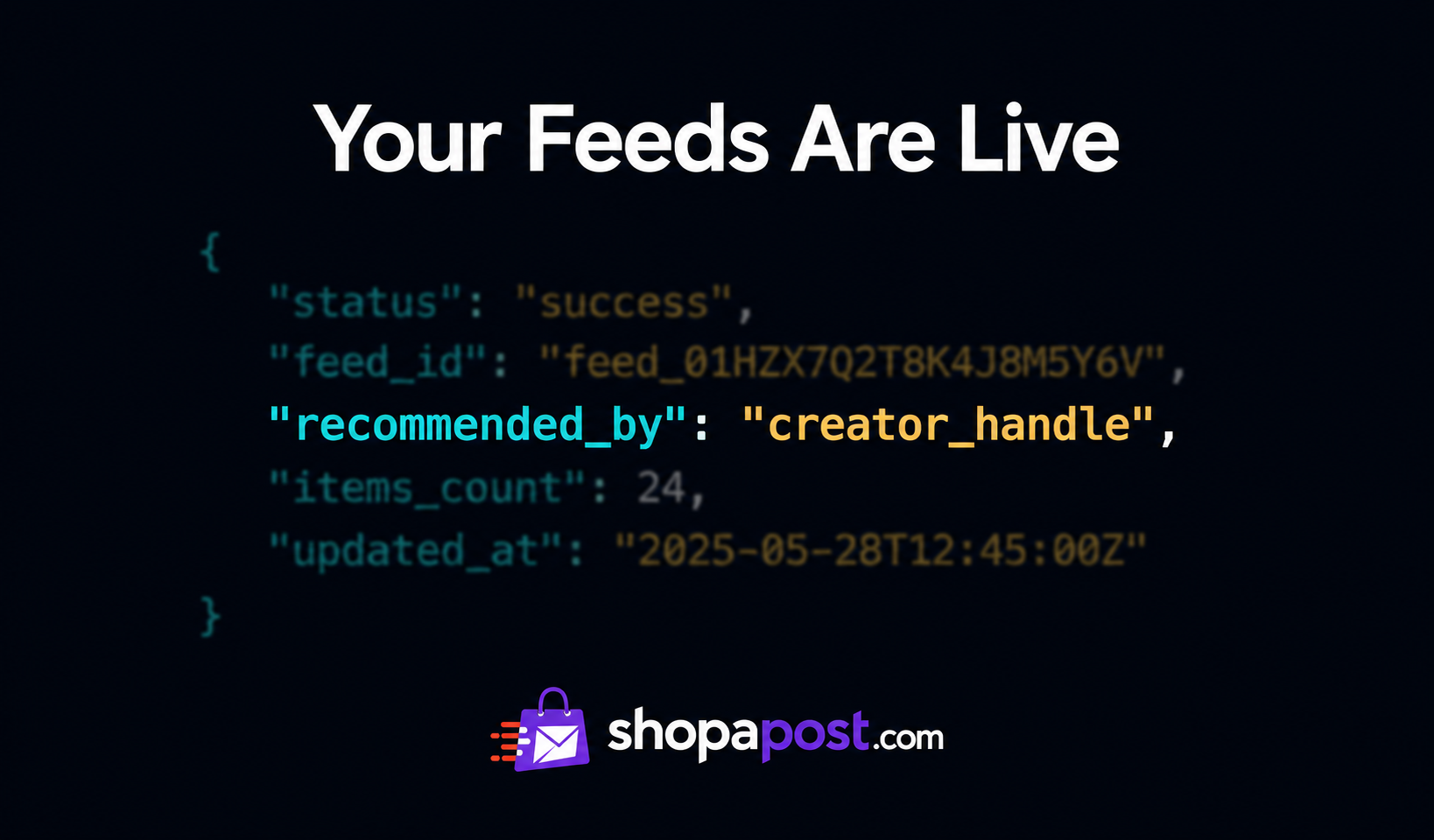
ShopaPost's public API now exposes structured product feeds with creator provenance, recommendation context, and real-time price freshness — built for the AI agents that are replacing the click.
The buyer making your customer's next purchase decision might not be your customer. It might be their AI agent — shopping on their behalf, comparing structured product data, and completing the transaction without a browser ever opening.
Google's Universal Cart, the Agent Payments Protocol, and ChatGPT's shopping mode are already live. The infrastructure for agentic commerce isn't coming. It shipped.
Starting today, ShopaPost's public API serves structured, agent-readable product feeds with something no other commerce platform provides: creator provenance on every product.
What We Built and Why It Matters
Most product feeds are merchant-centric. They tell an agent what a product is, what it costs, and where to buy it. They don't tell the agent who recommended it, why they recommended it, or what piece of content the recommendation came from.
That gap matters. When an AI agent is choosing between ten identical product listings across ten different feeds, the one attached to a trusted creator's recommendation — with context, rationale, and a verifiable content source — carries a signal the others don't. That signal is provenance, and ShopaPost is the only platform structuring it at scale.
Three Public Endpoints, Live Now
UCP Manifest — per-shop structured product data with full creator provenance. Each product includes the creator who recommended it, the source content URL, a recommendation context explaining why the product was chosen, and a timestamp. Available at /api/public/ucp/{shop-slug}.
Merchant Feed — a paginated JSON feed of all agent-buyable products across the platform, following Google Merchant Center field conventions with added ucp_eligible and agent_buyable flags. Products with stale prices or missing descriptions are automatically excluded. Available at /api/public/merchant-feed.json.
Agent Discovery — a standard /.well-known/agent-commerce.json endpoint that tells any agent crawling the domain where to find the feeds, what schema version they follow, and how pagination works. No authentication required on any endpoint.
The Schema
Every product in the UCP manifest carries this structure:
{
  "title": "Product Name",
  "brand": "Brand",
  "price": { "amount": 49.99, "currency": "USD" },
  "price_stale": false,
  "agent_buyable": true,
  "provenance": {
    "recommended_by": "@creator_handle",
    "recommendation_context": "Creator's rationale for
      recommending this specific product, in their voice.",
    "source_url": "https://youtube.com/watch?v=example",
    "added_at": "2026-06-01T12:00:00Z"
  }
}
That recommendation_context field is the line that separates this from every other product feed on the internet. It's not a product description scraped from a listing page. It's the creator's actual rationale for recommending this specific product — in their voice, from their experience.
What This Is For
If you're building an AI agent that shops on behalf of users, these feeds give you structured product data enriched with human trust signals that pure merchant feeds lack. The creator's name, the original content, and the recommendation rationale are machine-readable and verifiable.
If you're a creator, this is what protects your income as commerce goes agentic. When an AI agent completes a purchase that your recommendation sparked, the provenance record — your name, your content, your rationale — is the evidence trail that connects the sale back to you. Without structured provenance, you're invisible to agents. With it, your recommendation is a first-class data source in the purchase decision.
If you're an affiliate network, the attribution question for agentic commerce is unresolved. ShopaPost's provenance data provides a framework for how creator attribution could work when the click disappears. Every product in our feed carries the creator handle, the source URL, the timestamp, and the commission network. The audit trail exists.
What Comes Next
Price freshness is live — product prices refresh against source retailers on a rolling seven-day cycle, with a price_stale flag on every feed item so consuming agents know exactly how current the data is.
Brand enrichment is running across the full catalog, backfilling verified brand names from Amazon's Product Advertising API onto products that were previously unbranded.
Schema.org/Product JSON-LD is on every shop page, making creator-curated products crawlable by Google's Shopping Graph without requiring a Merchant Center account.
The feeds are public. The endpoints are documented. The schema is versioned and stable. If you're building in agentic commerce and want structured product data with creator provenance attached, start here:
- Agent discovery: shopapost.com/.well-known/agent-commerce.json
- Merchant feed: shopapost.com/api/public/merchant-feed.json
- UCP manifest (example): shopapost.com/api/public/ucp/knipex-evostrip-16-self-adjusting-insulation-stripper
The infrastructure for agentic commerce is live. The question is whether your recommendations are structured enough to survive it. Build your shop and find out.
Creator commerce changes every week. I read everything so you don't have to.
One email a week. What's working in affiliate and creator commerce right now, from someone doing this since 1997. No fluff, no pitch fests, unsubscribe anytime.